
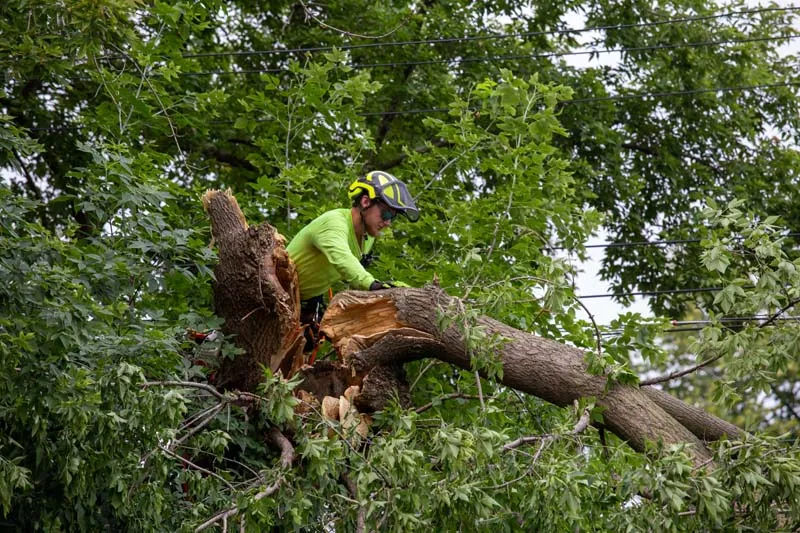
Silver maple was planted heavily across Southeastern Michigan through the middle of the last century because it grows fast and gives shade quickly. Those trees are now large, old, and over houses, and they are among the most common trees we are called out for after a storm.
Why they fail
Fast growth makes weak wood. Silver maple puts on size quickly and the wood is comparatively brittle. Add the habit of forming narrow, V shaped forks with bark pinched inside the joint, and you get unions that split under ice or wind load. A big silver maple can drop a limb the size of an ordinary tree.
What to look for
- Tight V shaped forks, especially with a seam or dark line running down from the crotch.
- Deadwood in the canopy. Bare branches scattered through the crown, particularly at the top.
- Cavities and old wounds where a limb tore out previously.
- Fungus at the base. Shelf fungus or mushrooms around the root flare means decay in the part of the tree that matters most.
- Surface roots lifting driveways, walks or the lawn, which is a clue to how shallow the root system is.
What can be done short of removal
Not every silver maple needs to come down. Options include reducing the length of over extended limbs so there is less leverage, removing deadwood, and cabling a weak union so the two halves support each other. Cabling and bracing works well on a tree that is structurally sound apart from one bad fork.
Where the trunk is decayed, or a major union has already split, removal is the honest answer. A split that has started rarely stops.
What to plant instead
If you are replacing one, there are better choices for a yard tree in this area: sugar maple, red maple, oak, hackberry, or a Kentucky coffeetree if you want something less common. They grow more slowly and hold together far better in a storm.
Common Questions
Does every silver maple need to come down?
No. Many can be kept by reducing over extended limbs, clearing deadwood and cabling a weak union. Removal is the answer when the trunk is decayed or a major union has already split.
How can I tell a silver maple from a sugar maple?
Silver maple leaves are deeply cut with silvery undersides that flash in the wind, and the bark on older trees is shaggy and flaking. Sugar maple leaves are firmer with shallower notches.
Is cabling permanent?
No. Cables need inspecting periodically and eventually replacing, and they support a tree rather than fix it. They buy time on an otherwise healthy tree.
Get a Free Estimate
If you have a big silver maple over the house, a look now beats a call at midnight in July. Tip Top Timber Co. is based in Armada and works throughout Macomb County, St. Clair County and the surrounding area. Call (586) 651-5488 or send us a message for a free estimate. If a tree is already down, our 24 hour line is (586) 651-4552.
