
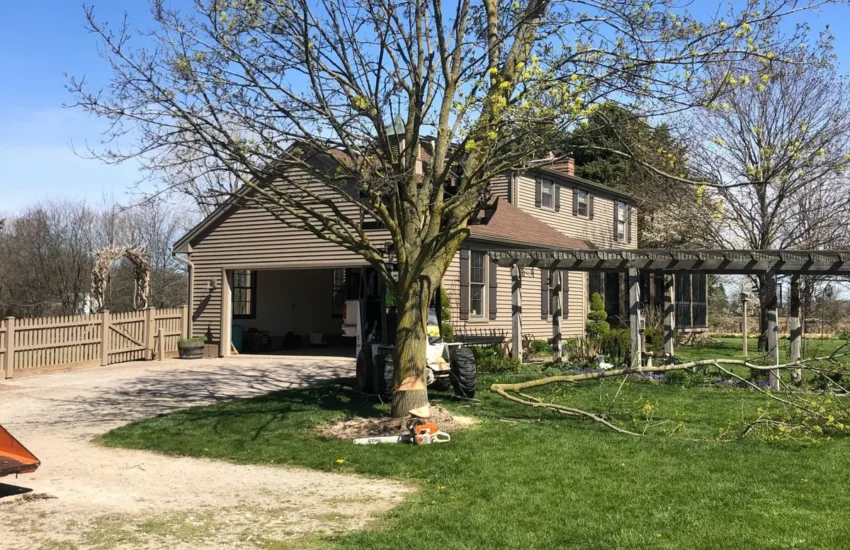
Drive through Armada, Romeo, Washington Township or Richmond and you see the same handful of trees over and over. Each one fails in its own way, and knowing which you have tells you what to watch for.
Maple
Sugar and red maple are solid yard trees that need little beyond occasional deadwood removal. Silver maple is the problem child: fast, brittle and prone to splitting at narrow forks. Norway maple, common in subdivisions, casts such dense shade that little grows under it and tends toward girdling roots that strangle the trunk over time.
Oak
Long lived, strong wooded, and worth keeping. The main caution is timing: prune in the dormant season to avoid oak wilt. Oaks also hate having their root zones compacted or regraded, which is why an oak often starts declining a couple of years after construction work nearby.
Ash
Mostly dead here after emerald ash borer. Dead ash goes brittle quickly and should not be left standing near anything you care about.
Spruce
Colorado blue spruce is planted everywhere in this area, and it is frequently unhappy in Michigan yards. Browning that starts on lower inner branches and works upward usually points to needle cast disease, particularly on trees planted too close together where air does not move.
White pine
Michigan’s state tree, and a good one, though it is soft wooded and sheds limbs in ice storms. Old white pines near houses deserve attention after heavy ice.
Willow
Fast, thirsty and messy. Willows drop limbs constantly and their roots go looking for water, including drain lines and septic fields. Fine at the back of a wet acre, a poor choice near the house.
Honey locust and black locust
Common along fence lines and in older yards. Honey locust holds up reasonably well; black locust tends toward decay and drops limbs as it ages.
Box elder
A maple relative that turns up wherever nobody is mowing: fence lines, ditch banks, the back of the property. Weak wooded, short lived, and the classic candidate for clearing along a fence line.
When to be concerned about any of them
Whatever the species, the same signals matter: a new lean, fungus at the base, deadwood in the upper canopy, splits at major unions, and roots heaving on one side. Any of those is worth a look.
Common Questions
What is a good replacement shade tree for this area?
Sugar maple, red maple, oak, hackberry and Kentucky coffeetree all do well here and hold together far better in storms than silver maple or willow.
How far from the house should a tree be planted?
It depends on the mature size of the species, not the size at planting. A large shade tree wants room for a full canopy well clear of the roof and the foundation.
Why did my tree start declining after construction?
Trenching and grading cut roots and compact the soil the tree depends on. Decline often shows up a year or two later, which is why the connection gets missed.
Get a Free Estimate
Not sure what you have got or whether it is healthy? We will walk the property with you. Tip Top Timber Co. is based in Armada and works throughout Macomb County, St. Clair County and the surrounding area. Call (586) 651-5488 or send us a message for a free estimate. If a tree is already down, our 24 hour line is (586) 651-4552.
